The Galway Commuter Belt: Where to Buy Near Galway for Less
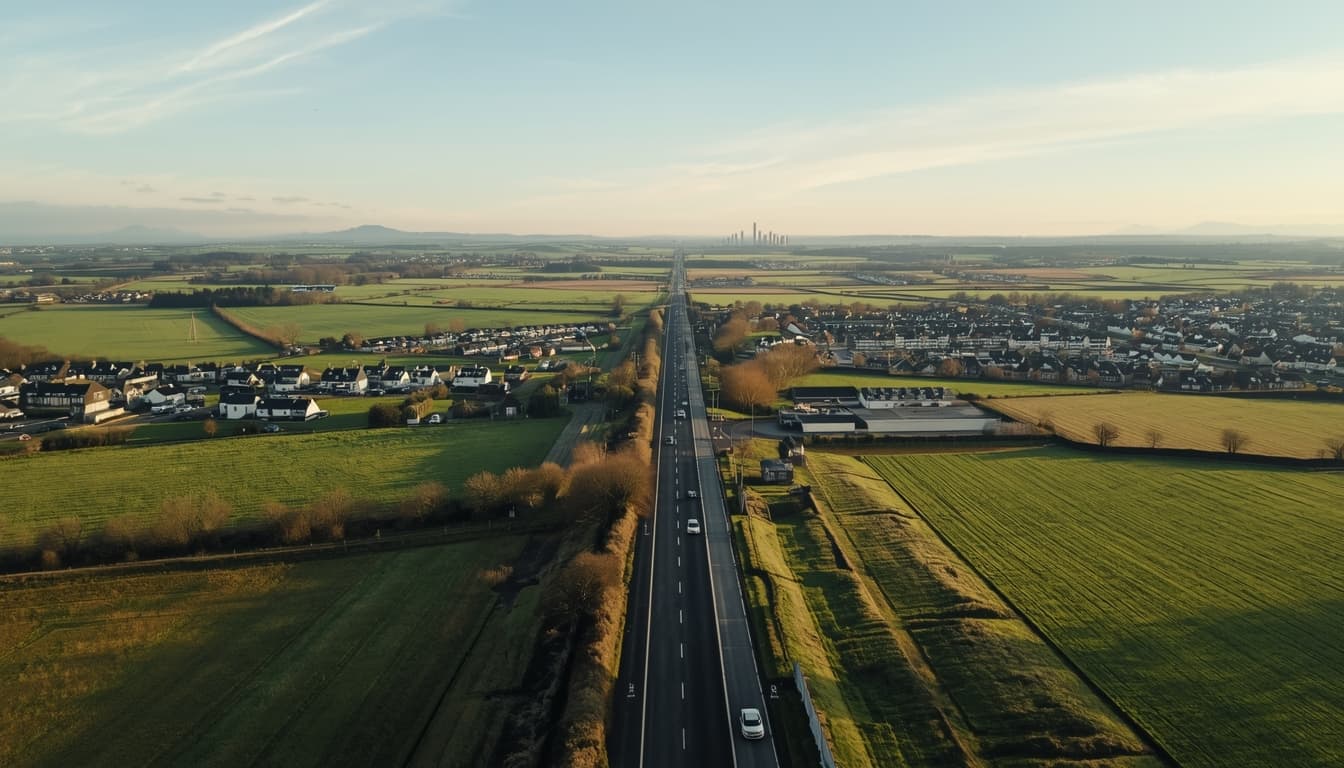
Galway has a congestion problem that Cork and Dublin don't: it ranks 42nd in the world for hours lost to traffic — in a city of 85,000 people. Peak speeds average 20mph. The average commuter loses more than four full days every year just sitting in traffic. With 79% of cars entering the city carrying a single occupant, the choice of where you live isn't just about price — it's about which corridor you're stuck in. We matched 11,000+ property sales across Galway and its commuter towns with real drive times, train frequencies, and bus routes to find where prices actually drop — and whether the commute is worth it.
The short version: Oranmore at 12km costs €49,627 more than the city — the train premium is fully baked in. Athenry at 24km with ~20 trains/day costs virtually the same as the city (€348,018 vs €350,000). The first real cliff drops at 34–38km, where Loughrea and Tuam save you €60,000–€100,000. And then there's Ballinasloe — 60km east, train that takes longer than driving, and a €202,000 median that saves you €148,000 vs the city.
The Congestion Problem
Galway ranks in the top 4% of 1,000 cities globally for congestion (INRIX 2025 Global Traffic Scorecard), despite having a population of around 85,000. Peak speeds in the city average 20mph against an off-peak average of 32mph — a 37% drop. The N6 eastbound and N17 northbound are the two worst bottlenecks: both corridor entrances have peak-hour delays that can double or triple off-peak drive times for towns directly on those routes.
Dashed grey line = Galway city median (€350,000). The 0–20km band is more expensive than the city average — the reverse of what you'd expect.
Red = premium suburbs (above city median), Amber = first savings, Green = sweet spot, Purple = lifestyle premium.
What makes Galway unusual: the rail corridor has inflated the eastern suburbs far above their distance discount. Oranmore at 12km is €49,627 above the city median — the train premium priced straight in. Barna (7km west, premium coastal suburb) is €20,000 above. Moycullen and Claregalway are slightly below, but the savings are modest. You need to travel 34–38km before the discount is meaningful — and 60km before it's transformative.
Town-by-Town: Price, Drive Time & Transport
Galway has only four suburban rail stations: Oranmore, Athenry, Gort, and Ballinasloe — all on intercity routes, not dedicated commuter services. Outside that corridor, it's bus or car. Gort (40km south) has a station but only 5 trains/day on the Western Rail Corridor — not a practical commuter frequency.
Barna (€370,000), Oranmore (€399,627), Moycullen (€341,410), and Claregalway (€331,377) are not shown — all are more expensive than Galway city.
| Town | Band | Median | vs Galway | Drive | Train | Bus |
|---|---|---|---|---|---|---|
| Barna | Suburb | €370,000 | +€20,000 more | 11 min | No train | 20 minFrequent · Bus Éireann city |
| Oranmore | Suburb | €399,627 | +€49,627 more | 13 min | 10 min~20/day — peak every 30–45 min | 27 minEvery 30 min · Bus Éireann 404 |
| Moycullen | Suburb | €341,410 | -€8,590 (2.5%) | 20 min | No train | 28 minSeveral daily · Bus Éireann |
| Claregalway | Suburb | €331,377 | -€18,623 (5.3%) | 17 min | No train | 25 minHourly · Burkesbus 435 / Bus Éireann 64 |
| Athenry | Cliff Edge | €348,018 | -€1,982 (0.6%) | 22 min | 20 min~20/day — best suburban rail in Connacht | 35 minSeveral daily · Buslink / Bus Éireann |
| Headford | Cliff Edge | €336,000 | -€14,000 (4.0%) | 28 min | No train | 40 minSeveral daily · Bus Éireann 456 / Burkes 435 |
| Loughrea | Cliff Edge | €290,000 | -€60,000 (17.1%) | 30 min | No train | 32 min3–5 daily (limited) · Citylink / Healy Bus |
| Tuam | Cliff Edge | €250,000 | -€100,000 (28.6%) | 33 min | WRC planned — funding confirmed Nov 2025 | 45 minSeveral daily · Bus Éireann 64 / Bus Feda |
| Ballinasloe | Sweet Spot | €202,000 | -€148,000 (42.3%) | 40 min | 46 minEvery ~2 hrs (~9/day). Drive is faster. | 60 minEvery 4 hrs · Citylink |
| Portumna | Sweet Spot | €168,500 | -€181,500 (51.9%) | 58 min | No train | Local Link only (2–3/day) |
| Clifden | Lifestyle | €247,500 | -€102,500 (29.3%) | 75 min | No train | 95 minSeveral daily (slow) · Bus Éireann 419 / Citylink |
| Westport | Lifestyle | €302,500 | -€47,500 (13.6%) | 75 min | Train goes Dublin via Athlone — no Galway rail | 90 minSeveral daily · Bus Éireann 456 / Healy Bus |
Drive times are off-peak. Add 15–30 min for morning rush hour on the N6 and N17 corridors. Median prices based on 2021–2026 PPR sales.
The Athenry Effect
The eastern rail corridor is Galway's strongest commuter infrastructure — and it shows in the prices. Oranmore (12km) has a running train service with roughly 20 services per day on a combination of the Dublin–Galway intercity, Galway–Limerick Western Rail Corridor, and local Galway–Athenry services. The journey to Ceannt Station takes 10 minutes. At peak hours, trains run every 30–45 minutes.
Oranmore's median is €399,627 — €49,627 above the city. A 12km, 10-minute-by-rail suburb costing more than the city is the clearest possible statement of how much buyers value a fast, frequent rail connection.
The Athenry number is even more striking. At €348,018, Athenry costs virtually the same as Galway city itself. The median gap is just €1,982 — essentially statistical noise. Twenty services a day, 20 minutes to the city, on the best-served suburban rail node in Connacht — all routes from the western seaboard converge here. Buyers have priced every minute of that journey time out of the discount.
Compare Athenry with Headford (25km north, no train): median €336,000 — €12,000 cheaper than Athenry despite being a nearly identical distance. No train means no premium. The gap between the two towns is almost entirely explained by infrastructure.
2026 upgrade: Irish Rail is investing €12m in a second platform and 1km passing loop at Oranmore. Once built, it will allow trains every 15–20 minutes on the Athenry–Galway corridor. Oranmore is already expensive. Post-upgrade, that gap will widen further.
The N17 Tax: Tuam & Loughrea
The 34–38km band is where the first meaningful savings arrive — and where the road you're on matters as much as the distance.
- Tuam (38km) — the M17 transformation. The M17/M18 motorway opened in 2017, cutting the Galway–Tuam journey from a congested 45-minute crawl on the old N17 to around 33 minutes off-peak. At €250,000, Tuam saves you €100,000 vs the city — a 28.6% discount. No train, though the Western Rail Corridor extension (Athenry–Claremorris via Tuam) has funding confirmed as of November 2025, with clearance works expected to start in 2026. The caveat: while the M17 handles the open road well, the last stretch from Claregalway into Galway city remains a significant bottleneck at peak hours. Budget 45–55 minutes for a morning commute.
- Loughrea (34km) — the quiet corridor. Southeast on the N66 — a quieter road with significantly less congestion than the N17. Off-peak is 30 minutes. At €290,000, it saves €60,000 vs the city. The bus (Citylink/Healy) runs 3–5 times daily — limited compared to the rail towns but functional for flexible workers. Better road, similar savings, less talked about.
Ballinasloe's M6 Paradox
Ballinasloe sits 60km east of Galway on the M6 motorway, with a train station on the Dublin–Galway intercity line. It has a €202,000 median — €148,000 cheaper than the city. It also has an unusual distinction: the drive is faster than the train.
The M6 motorway makes the 60km journey about 40 minutes off-peak. The train takes 46 minutes. This is the reverse of how rail commuting is supposed to work — normally, the train wins on time once you factor in parking and last-mile transport. At Ballinasloe, the motorway is simply too good.
- The train is still useful. You don't need to park, you arrive in the city centre, and you can work on the journey. But at ~9 services/day (every two hours), it's an intercity schedule, not a commuter service. You're working around the timetable rather than the other way around.
- The perception gap is the price story. Ballinasloe has better road and rail access than Athenry (24km, €348,018). Yet the median is €146,000 cheaper. Buyers mentally discount it for being "at the edge of Connacht." The data doesn't support that discount.
- For first-time buyers, the maths are hard to ignore. At €202,000, the minimum deposit is €20,200 and the monthly mortgage (4%, 30yr, 90% LTV) is around €868. That's a different financial life to buying near Athenry.
Portumna (65km southeast) is a different story: no train, regional roads, Local Link buses running 2–3 times daily via Loughrea. At €168,500, it's the cheapest major town in this analysis — €181,500 below the city. For fully remote workers, that's a compelling number. For anyone commuting three days a week, it's impractical.
Clifden & Westport: Remote-Work Territory
- Clifden (80km west) — the N59 is one of the most scenic roads in Connacht and one of the most winding. Google Maps says 75 minutes; in reality it's longer in wet weather. Bus Éireann Route 419 and Citylink run several times daily but the journey is 95+ minutes. At €247,500, this is priced as a lifestyle and holiday market, not a commuter one.
- Westport (80km north) — has a train station, but it's a red herring for Galway commuters. The Westport line runs east to Dublin via Athlone — there is no direct Westport– Galway rail service. Bus Éireann Route 456 covers the journey in about 90 minutes. The €302,500 median reflects Mayo and remote-worker demand. For someone needing Galway regularly, neither bus nor drive (75 min) is practical daily.
The Practical Takeaway
Here's what the data actually says:
- Galway's nearest suburbs cost more than the city. Barna, Oranmore, Moycullen, and Claregalway are all priced above the city median. You're buying into a premium suburb, not a commuter discount. Oranmore in particular — 10 min by train — is expensive and getting more so with the 2026 capacity upgrade.
- Don't pay the Athenry premium blind. The ~20 trains/day make it excellent for commuting. But at €348,018, that convenience is almost entirely priced in. Headford at €336,000 gives you a similar car commute time for less — if you're driving anyway, the price difference matters more than the train.
- The sweet spot is 34–38km: Loughrea or Tuam. Loughrea has the calmer road (N66, minimal congestion) and 3–5 daily buses. Tuam has the M17 motorway (33 min off-peak) and a rail connection coming via the Western Rail Corridor. Both save you €60,000–€100,000 vs the city. For hybrid workers, this is the obvious target.
- Ballinasloe is undervalued by perception. M6 motorway, a train station, €202,000 median. The catch: trains run every 2 hours and the drive is actually faster. But for anyone flexible on schedule, this is the best value-for-commute town in the Galway belt. The price discount far outweighs the distance stigma.
- Congestion is the hidden multiplier. Off-peak times look workable. At 8:15am on the N6 eastbound or N17 northbound, add 15–30 minutes. A 12km drive to Oranmore at rush hour takes 30–45 minutes. A 60km M6 drive to Ballinasloe takes 40 minutes. Corridor choice matters more in Galway than in almost any city in Ireland.
The bottom line: Galway rewards buyers who are willing to go further — or pick the right corridor. Inside 20km you often pay more than the city. At 34–38km on the M17 or N66, you save meaningfully. At 60km on the M6, you get the biggest discount in Connacht for a commute that actually works. The city's congestion problem makes motorway distance more valuable than proximity through gridlock.
Explore Galway property prices
Search actual sale prices in any Galway town, or calculate what you can afford with our mortgage tools.
Related Articles

The Best Month to Buy a House in Ireland (727,000+ Sales Analysed)
We crunched 14 years of Property Price Register data to find the cheapest month to buy. March comes out on top — with potential savings of €15,000 nationally.

The Cheapest (and Most Expensive) Eircodes in Ireland (310,000+ Sales)
We ranked every Eircode routing area by median sale price. A94 tops the list at €710k while H23 comes in at €135k — a 5x difference across just 140 areas.

Which Counties Are Getting More Expensive the Fastest? (2021–2025)
Sligo prices jumped 64% in four years while Wicklow managed just 12.5%. We tracked median prices across all 26 counties from 2021 to 2025.
 Buy me a coffee